
Getting into retro console collecting
Choose a retro system, judge pre-owned condition, understand loose and CIB games, learn grading basics, and avoid reproductions before paying.
Updated November 10, 2026 · Sources last checked November 13, 2026
Our take
Start with one console you genuinely want to play, then buy the cleanest, best-documented example your budget allows. Nintendo’s NES, Game Boy, Super NES and N64 offer distinct collecting paths, while the original PlayStation suits buyers drawn to disc games and early 3D hardware.
For playing, begin with a tested console and loose games; for display, look at boxed copies once you understand what belongs in the set. Graded games make the most sense as protected display pieces, not as the default format for learning the hobby.
Choose a lane before you buy
Retro collecting gets expensive when “everything” becomes the plan. Pick a console generation, a series, a region, a genre or a short list of childhood favourites. A focused collection gives you time to learn which releases, packaging variations and replacement parts are normal for that system.
Nintendo’s official history gives a useful outline of Nintendo’s North American console history. The NES launched in North America in 1985, Game Boy arrived in 1989, Super NES followed in 1991, and Nintendo 64 launched in the United States on September 29, 1996. Game Boy was introduced as Nintendo’s first portable handheld game system, while the N64 launch was paired with Super Mario 64.
The original PlayStation is a different collecting experience. Sony dates its North American release to September 9, 1995, and describes the console’s use of CD-ROM games, including larger titles such as Final Fantasy VII. The same history page highlights its move into real-time 3D with games including Tekken, Ridge Racer, WipEout and Crash Bandicoot. That makes PlayStation a natural choice for collectors who prefer disc-based releases and early polygonal games.
| System family | Collecting angle | Practical buying focus |
|---|---|---|
| NES / Super NES | Decide how much original packaging and documentation matters | Compare the exact box, manual and game shown in the listing |
| Game Boy | Portable hardware with physical games | Request clear photographs of the exact hardware and game, and confirm the condition matches the description |
| N64 | Decide how much original packaging and documentation matters | Confirm that the game is compatible with your console’s region |
| Original PlayStation | CD-ROM games with original and later console variations | Check the exact disc, case and included paperwork shown in the listing |
Condition is more than a grade
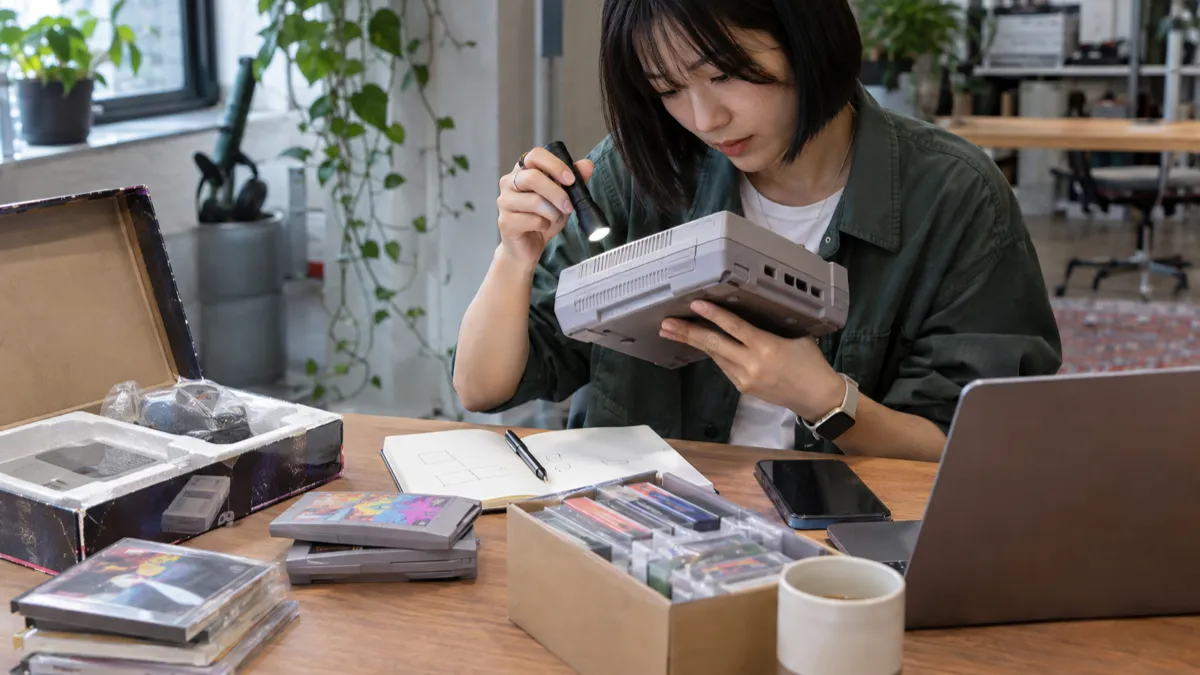
A clean photograph can hide the parts that matter most. For a console, ask for clear images of the exact unit and confirm that the seller has tested it if playability matters to you. A console that looks excellent but has not been tested may still be a poor foundation for a playing collection.
Ask to see the particular cartridge or disc you would receive, including the surfaces relevant to its condition. Swappa’s used-media guide notes that cartridge contacts can become dirty or corroded, older save-enabled cartridges may rely on replaceable batteries, and deep disc scratches can cause read errors. Those are practical reasons to ask what has been tested and what repairs or replacements have already been made.
Do not confuse cosmetic restoration with originality. Replaced shells, new labels, reproduction manuals and aftermarket cases can be reasonable for a playing collection, but they should be described clearly. If a listing does not say which parts are original, assume you still need evidence before paying a collector’s premium.
- Ask for a power-on or gameplay test, not only a photograph of the hardware.
- Confirm the region and included cables or controllers before buying.
- Check paper components separately: box, manual, inserts, maps and registration material.
- Treat missing, replaced or unusually perfect packaging as a reason to investigate.
Loose and CIB serve different goals
“Loose” generally means the game itself without its original packaging. It is a sensible format for people who want to play, build a library around a limited budget or avoid storing fragile cardboard. Loose does not mean poor condition: a well-kept cartridge with a readable label may be a better purchase than a damaged box assembled around an ordinary game.
CIB usually means the game is accompanied by its original packaging and printed materials, but the expected contents depend on the specific release. PSA’s current service covers loose cartridges, complete-in-box games and sealed media, while its CIB guidance stresses that the relevant parts can vary between versions.
Different editions can leave a supposedly complete copy with mismatched parts. PSA documents component variants and warns that the box, game, manual and inserts need to correspond to the same release. For a specific title and region, compare the box, manual and game against a reliable reference before paying for a highly complete example.
Grading is preservation, not permission to overspend
Professional grading combines authentication, condition assessment and encapsulation. PSA says it accepts loose cartridges, CIB games and sealed media, and its service describes authentication, grading and protective encapsulation. The result can be useful for cataloguing and display, but a slab does not make an ordinary game rare or turn an uncertain release into a documented original.
Grading also changes how you use the item. A sealed or encapsulated copy is principally a display object, while a loose or CIB copy can be handled, played and upgraded over time. For most newcomers, it is better to learn the hobby with playable examples and reserve grading for a favourite title whose condition, originality and personal importance justify the extra cost.
Read the label as carefully as the number. A grade records the grader’s assessment of that particular object; it does not replace your understanding of the release, its region or whether the components belong together.
Reproductions need a clear boundary
A reproduction can be an openly made replacement cartridge, box, label or manual, or it can be presented in a way that encourages the buyer to mistake it for an original. The buyer-level rule is simple: never pay an original-collectible premium for an item whose parts or status are unclear.
Start with the listing description, then compare the photographs with reliable references for the exact region and release. GameSpot’s reporting on game verifiers describes the risk of bootlegs in popular retro titles, while Swappa recommends checking the media, region and compatibility before purchase. Keep the check at that level: ask the seller to state whether the item is original, restored, modified or a reproduction.
Ask direct questions in writing: which components are original, has anything been replaced, and is the game a reproduction or modification? Keep the answer with your purchase records. If the seller cannot answer basic provenance questions, choose a common title from a more transparent seller instead of trying to solve an uncertain authentication problem after payment.
Buy the shelf you can live with
For a first purchase, make the console and one or two games the test of your collecting plan. Play them, inspect how much storage and maintenance they need, and notice whether you care more about the experience, the object or the hunt. That answer should determine your next purchase more than a rarity list does.
Use protective sleeves or cases for paper-heavy releases, keep cardboard away from direct sun and damp, and avoid aggressive cleaning that can damage labels or artwork. Photograph the item and record its region, variant, condition and any replacements while the details are fresh.
The U.S. Consumer Product Safety Commission maintains a searchable database of recalls and product-safety warnings. Its database is updated weekly, while remedy information can change daily, so check the current entry before using an older console, power adapter or accessory. No specific recall is asserted here for the console families discussed; the CPSC search is the appropriate place to verify a particular model or accessory.
Sources
- Nintendo Our History
- PlayStation history timeline
- PSA Video Game Grading Services
- PSA CIB video game service update
- Buying Used Physical Games: Discs, Cartridges and Codes
- Used Retro & Classic Consoles: What to Know Before You Buy
- GameSpot: Meet The Game Verifiers Guiding Retro Collectors Through A World of Fakes
- U.S. Consumer Product Safety Commission recalls
Specifications vary by model and reference — always check the individual listing.