
Sony A7 III vs A7 IV: Is the Upgrade Worth It?
Sony’s A7 IV brings better autofocus, 10-bit video and a flexible screen, but a used A7 III remains the smarter stills buy for many photographers.
Updated October 18, 2026 · Sources last checked November 13, 2026
Our take
Buy the A7 IV if you shoot a serious mix of stills and video, need dependable subject tracking, or expect to crop heavily; its screen, autofocus and 10-bit video make the extra cost easier to justify. Choose a clean used A7 III if photography is the priority and the saving can fund a better lens, spare battery or travel kit. For most A7 III owners, this is a targeted upgrade rather than an urgent replacement.
The sensor changes how much detail you can keep
The A7 III uses a 24.2-megapixel full-frame sensor, while the A7 IV has approximately 33 effective megapixels. That is a useful increase rather than a completely different class of camera: the IV leaves more room to crop wildlife, events and travel photographs, and gives large prints more fine detail to work with. DPReview describes the A7 III as a strong all-rounder whose 24MP files remain suitable for a wide range of photography, while RTINGS found the A7 IV produces detailed images with wide dynamic range.
The A7 III’s lower resolution is not automatically a weakness. Its files are smaller to store and process, and the camera still delivers the familiar full-frame advantages of depth of field and low-light flexibility. Do not upgrade for resolution alone unless you regularly crop or print large; lens choice, light and framing will usually have a larger effect on the final photograph.
| Area | Sony A7 III | Sony A7 IV |
|---|---|---|
| Full-frame resolution | Approximately 24.2MP effective | Approximately 33MP effective |
| Autofocus | 693 phase-detection points plus contrast detection | Newer tracking and subject-recognition system |
| Video | Full-width oversampled 4K/24p; cropped 4K/30p; 8-bit recording | Internal 10-bit recording; 4K/60p with a crop |
| Rear screen | 3-inch touch LCD, 921,600 dots; tilting design | 3-inch touch LCD, approximately 1.03 million dots; fully articulating design |
| Battery | Sony NP-FZ100; CIPA rating of 710 shots in DPReview’s review | Sony NP-FZ100; CIPA rating of 580 shots by LCD or 520 by EVF in DPReview’s review |
Autofocus is the clearest everyday upgrade
The A7 III’s autofocus is not obsolete. Sony specifies phase- and contrast-detection focusing, and DPReview recorded 693 phase-detection points covering 93 percent of the frame. Its review found the system highly capable for general photography, including portraits, weddings, events and sports, provided the subject and background are not unusually difficult.
The A7 IV feels more current because tracking and subject recognition are more deeply integrated into the autofocus experience. DPReview describes its autofocus and interface as substantial advances over the A7 III, while RTINGS rated the newer camera’s face and eye tracking strongly in testing. That difference matters most for children, animals, event candids and video, where keeping focus through a changing scene can prevent more missed frames than an extra few megapixels. It matters less for landscapes, architecture or posed portraits where you can place the focus point yourself.
Video is where the IV earns its premium
The A7 III can still produce very good 4K footage. DPReview notes that it oversamples 4K/24p from the full sensor width and records 4K/30p from a cropped area. It also provides microphone and headphone connections, making it a sensible choice for occasional clips, interviews, family films and photographers who treat video as a secondary feature.
The A7 IV is a much more convincing hybrid. DPReview lists internal 10-bit video, H.265 recording and full-width oversampled 4K up to 30p, while RTINGS highlights the camera’s 10-bit 4:2:2 recording and Log options. Those modes preserve more colour information for grading than the A7 III’s 8-bit files. The IV also supports 4K/60p, but that frame rate uses a Super35 or APS-C crop, so it narrows the view rather than providing a free route to slow motion.
The fully articulating screen helps with self-recording, low angles and gimbal work, and the improved autofocus makes face-focused shooting easier. There are trade-offs: RTINGS describes the IV as bulky for walk-and-talk vlogging and reports shorter video battery life than the predecessor. For a stills-first buyer who does not plan to grade heavily, the A7 III may therefore be the better bargain. For paid video or a serious hybrid workflow, the IV’s bit depth, screen and focusing tools are meaningful improvements.
The screens and controls change how the cameras feel
The A7 III has a tilting 3-inch touch display with 921,600 dots and a 2.36-million-dot electronic viewfinder. That arrangement works well for ordinary horizontal and waist-level shooting, but it is awkward when the camera points toward you or sits low. Its menus and controls also feel older beside the A7 IV.
The A7 IV adds a side-opening, fully articulating screen and a newer menu system. RTINGS specifically found the menu system improved, and DPReview lists a 3.69-million-dot viewfinder. RTINGS also notes that both of the IV’s card slots support UHS-II, with one accepting CFexpress Type A as well. That makes the newer body more attractive for photographers who move between stills and video or need a faster media workflow.
The IV’s screen is not automatically better for every stills photographer. Some people prefer a simple tilt because it stays close to the optical axis and can be quicker for discreet low-angle work. If you use a cage, tripod plate or external microphone, inspect the hinge and grip in person if possible.
Battery life is close enough to share a system
Both cameras use Sony’s NP-FZ100 battery, so an A7 III owner moving to an A7 IV does not have to replace the entire battery system. DPReview gives the A7 IV CIPA ratings of 580 shots with the rear screen and 520 with the electronic viewfinder, while its A7 III review lists a 710-shot CIPA rating. These laboratory figures are most useful for comparing the bodies, not for predicting every shoot.
The A7 III’s stronger stills rating is one reason it remains appealing for travel and event work. The IV’s newer processor, larger feature set and video demands make spare batteries sensible for long recording days. With any used body, budget for a known-good battery and test charging, battery recognition and USB power before an important trip.
Used buying rewards careful inspection
The A7 III is most attractive as a used stills camera, provided the body is priced as an older design rather than treated like a current model. The A7 IV is the safer choice if you want to keep the body for years, need current video features, or expect autofocus improvements to reduce missed shots. Sony announced the A7 IV in October 2021 at a recommended US body-only price of $2,499, according to Sony’s announcement and DPReview’s report; that is historical context, not a present-day price.
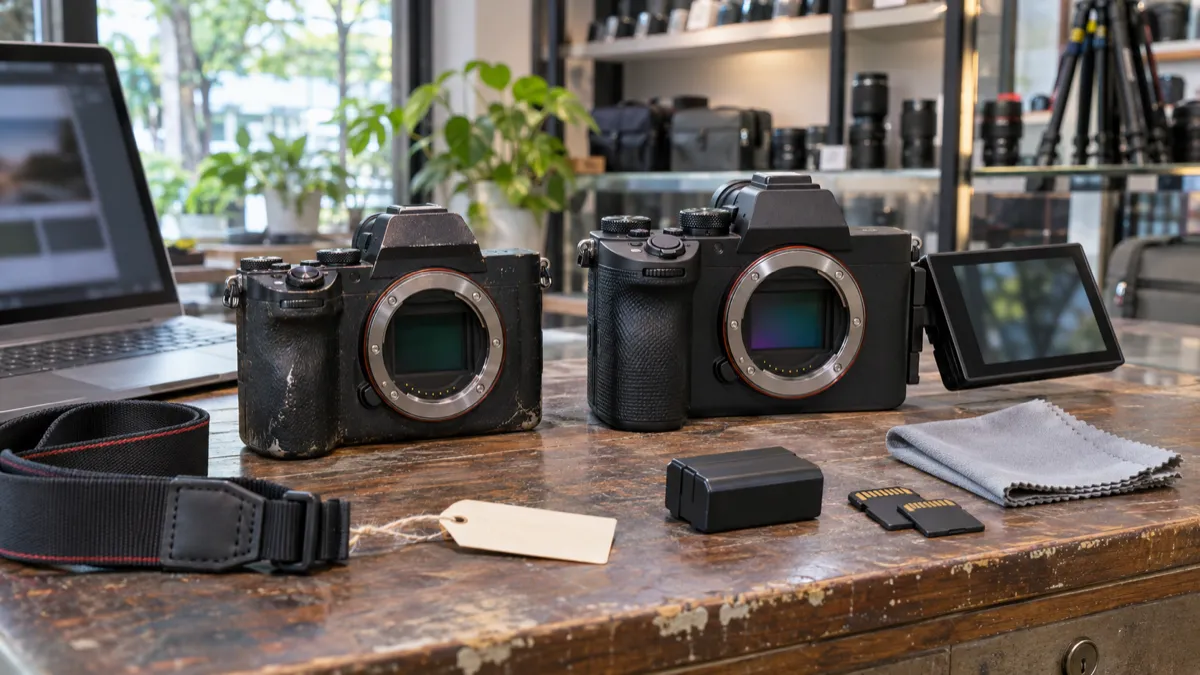
On a used listing, start with the exact model identifier: ILCE-7M3 and ILCE-7M4 are the relevant full-frame bodies, not an A7R, A7S or A7C variant. Ask for clear photographs of the mount, sensor area, hot shoe, card doors, battery compartment, screen hinge and ports. Look for impact marks around the mount and tripod socket, corrosion or grit in doors, a damaged screen coating, loose dials and a grip that has started to lift. Surface wear is normal; unexplained deformation, moisture evidence or intermittent controls deserve a pass.
Request an unedited sample at a low ISO and another at a higher ISO, plus a short video clip if video matters to you. Check that both card slots write and replay, autofocus locks on a moving subject, the touchscreen responds across its surface, the viewfinder is clear, the microphone and headphone sockets work, and the sensor does not show an unusual fixed mark at a narrow aperture. Confirm what is actually included: genuine battery, charger or USB cable, body cap and the correct regional accessories.
eBay’s Authenticity Guarantee page describes physical inspection for eligible items and lists categories such as shoes, handbags, watches, apparel, jewelry, trading cards and coins; cameras are not listed on that page. Do not assume an A7 III or A7 IV listing has that service simply because another eBay category uses an authenticity checkmark. eBay Refurbished is a separate programme: its page describes vetted sellers, condition tiers, inspections and an Allstate-serviced warranty. A listing labelled merely “Seller Refurbished” should not be treated as part of that official programme.
- Before paying, verify the exact ILCE model and request photographs of the serial-label area.
- Test both card slots, every dial, the screen hinge, ports, autofocus, playback and USB charging during the return period.
- Prefer a listing with a clear return policy and a complete description of the included battery and accessories.
Sources
- Sony A7 III Help Guide: specifications
- Sony Electronics: A7 IV product page
- Sony Electronics: A7 IV announcement
- DPReview Sony A7 III review
- DPReview Sony A7 IV review
- RTINGS Sony A7 IV review
- eBay Authenticity Guarantee
- eBay Refurbished
- CPSC Recalls and Product Safety Warnings
Specifications vary by model and reference — always check the individual listing.