
Sigma FP2 vs Sigma FP: Is the New Modular Camera Worth Upgrading?
Sigma FP2 brings faster readout, improved autofocus, tilt screen and internal memory. We compare it with the FP and full-frame rivals.
Updated November 15, 2026 · Sources last checked November 15, 2026
Our take
Buy the Sigma FP2 if the original FP’s slow electronic readout, fixed screen, limited autofocus or recorder-dependent workflow is actively getting in your way. It is a meaningful operational upgrade for compact cinema rigs, faster-moving subjects and hybrid shooters who want 6K open-gate video, internal memory and a more usable screen.
Choose a refurbished Sigma FP when you mainly manual-focus, shoot from a tripod, work in a studio or controlled light, or want the FP’s DNG stills and cinema features at the lowest sensible acquisition cost. Choose a conventional rival instead if dependable continuous autofocus, stabilization, a built-in viewfinder or run-and-gun ergonomics matters more than the Sigma’s unusually small modular body.
What changed, and what did not
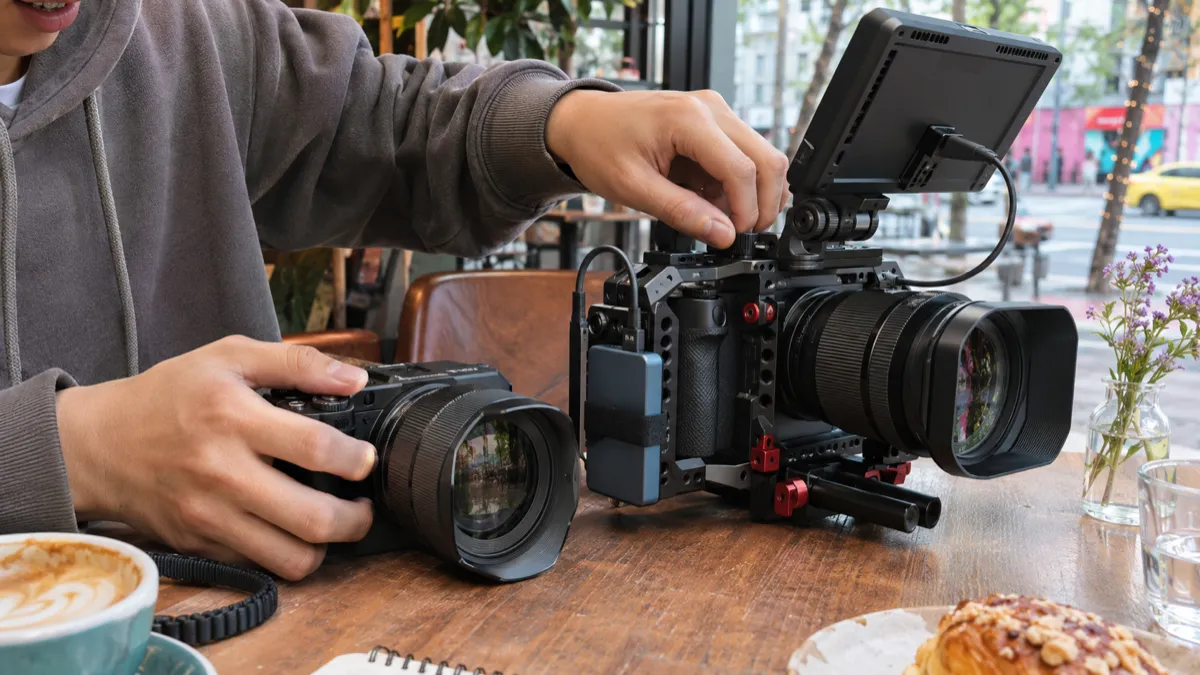
The FP2 keeps the original concept: an L-mount full-frame camera that becomes a stills body or cinema tool through accessories. The biggest changes are operational rather than cosmetic: a partially stacked sensor reads faster, autofocus gains phase detection and subject tracking, the screen tilts, internal memory is built in, and the connection layout is more useful for modern video accessories.
Sigma announced availability from November 11, 2026, at a $2,199 body-only MSRP. That is launch MSRP, not a current used-market price. Refurbished and pre-owned availability changes independently, so this guide deliberately does not publish marketplace prices.
| Difference that matters | Sigma FP2 | Sigma FP |
|---|---|---|
| Sensor and readout | 24.5MP partially stacked full-frame CMOS; DPReview measured 14.2ms single-shot and 11.1ms burst readout | 24.6MP full-frame CMOS with substantially slower readout; DPReview says FP2 is nearly twice as fast as the FP’s fastest 12-bit mode |
| Autofocus | Phase-detect plus contrast detection; human, dog, cat and bird tracking with Eye AF | Contrast-detect AF; adequate for static subjects and manual-focus workflows, but continuous AF is unreliable in independent testing |
| Screen | 3.15-inch, 2.1-million-dot tilt touchscreen; tilts up 90 degrees and down 45 degrees | Fixed rear LCD |
| Internal storage | Approximately 70GB internal memory, plus UHS-II SD and portable SSD support | No internal memory; SD card and external recording workflows |
| Video | 6K open gate reaches 30p; 6K 16:9/1.89:1 reaches up to 59.94/60p in supported modes; ProRes RAW output and compressed formats | 4K-oriented internal recording; CinemaDNG RAW requires external media or recorder workflow |
| Audio and ports | Full-size HDMI, two USB-C ports, seven-pin accessory interface and support for 32-bit float audio with compatible accessories | Micro HDMI and older accessory ecosystem; fewer integrated modern monitoring/audio options |
| Battery | Larger BP-91 battery supplied; Sigma and reviewers describe higher-capacity power design | Older BP-51 battery family |
| Accessories | New EVF-21, HU-21 and related accessories; compatibility must be checked individually | Original accessories are not automatically compatible with FP2; FP2 EVF-21 is not backward-compatible with the FP |
| Body and shutter | About 112.8 x 69.9 x 41.8mm and 460g with battery/card in TechRadar’s specification; electronic shutter only | Very compact, fixed-screen body; electronic shutter only |
| Stabilization | No conventional sensor-shift IBIS; electronic video stabilization is available in supported modes | No conventional IBIS |
Speed is the FP2’s most consequential upgrade
The FP2’s partially stacked sensor adds readout circuitry at the edge of the chip. That lets the camera scan the frame faster, which reduces the time difference between the top and bottom of an exposure. In practice, vertical lines bend less during pans, fast movement looks less skewed, and the electronic-shutter design is less fragile under artificial lighting.
DPReview measured 14.2ms in single-shot stills and 11.1ms in burst mode, roughly an 1/89-second scan in the faster setting. Its comparison describes the FP2 as nearly twice as fast as the original FP in its quickest 12-bit readout mode. The same faster behavior appeared in the tested 6K and 4K video modes, including 6K RAW output.
That is a real improvement, but it is not a mechanical shutter and it does not make the FP2 a conventional sports camera. DPReview reports a maximum full-frame flash-sync speed of only 1/50 second, or 1/60 second in crop mode. Fast pans, rotating subjects, LED lighting and rapid action can still expose the limits of an electronic shutter.
Image quality: similar full-frame foundations, different rendering priorities
Both cameras are built around roughly 24-megapixel full-frame sensors and record Sigma’s flexible 14-bit DNG still files. There is no evidence here for declaring the FP2 a dramatic dynamic-range or high-ISO winner. Lens quality, exposure, noise reduction and the way DNG files are processed remain more important than the generation label for most still photographs.
The FP2’s JPEG pipeline is more unusual. DPReview’s image-quality analysis explains that its Ultra HDR-oriented processing and base-exposure strategy reserve highlight headroom. Sigma’s FP2 specification lists stills base ISO values of 320 and 2500, while ISO 100 is available as a settable value. DPReview also notes that the HDR/Auto ISO behavior cannot simply be disengaged and may produce an odd-looking result, particularly in portraits. RAW/DNG users can avoid much of the baked-in rendering, but they still need to understand the camera’s exposure behavior.
For high ISO, expect the same broad full-frame advantage over smaller sensors, not a night-and-day FP2 revolution. The FP2’s benefit is that more of the scene can be captured reliably before processing: faster readout helps moving subjects and flickering light, while the underlying image-making character remains closely related to the FP.
| Image-making question | FP2 | FP |
|---|---|---|
| Resolution | 24.5MP effective; 6016 x 4012 still files | Approximately 24.6MP full-frame resolution |
| RAW flexibility | 14-bit lossless-compressed DNG; RAW plus JPEG possible | DNG RAW workflow with strong post-processing flexibility |
| JPEG rendering | Ultra HDR-oriented pipeline; DPReview notes unusual base-ISO and exposure implications | More conventional FP JPEG behavior, though independent testing also found its auto HDR mode could look strongly processed |
| Dynamic range and high ISO | No sourced evidence of a decisive generational image-quality advantage; faster readout is the clearer gain | Still capable of high-quality full-frame files, especially in controlled or deliberate shooting |
| Best workflow | Use DNG when maximum editing control matters; use JPEG when the HDR-oriented look suits the job | Use DNG for the FP’s strongest image-quality case and accept more operational compromises |
Autofocus: improved FP2, but rivals remain safer for moving subjects
The original FP uses contrast-detect autofocus. Digital Camera World found it appealing as a manual-focus video platform but criticized continuous AF, while ePHOTOzine measured slower focus response than typical competing mirrorless cameras and reported a lower success rate on an eye during portrait testing. Static subjects, single AF and manual-focus tools are a different story: focus peaking, magnification and a controlled scene make the FP perfectly workable.
The FP2 adds on-sensor phase detection, continuous and tracking AF, Eye AF and recognition for people, dogs, cats and birds. Sigma and hands-on reviewers report faster, more accurate tracking, including in low light, but the early independent coverage is not a complete laboratory comparison across every subject and video situation. Treat it as genuinely more usable than the FP, not as a replacement for Sony, Canon or Nikon’s mature subject-tracking systems.
Manual focus is a feature when the camera is part of a cinema rig. A focus puller, a follow-focus motor, a locked-off product shot or a deliberately staged interview does not need the camera to decide what matters. The problem appears when the same body is expected to follow a running child, a wedding processional or a presenter who moves toward the lens.
| Use case | FP2 | FP | Phase-detect rivals |
|---|---|---|---|
| Static subjects | Strong enough with single AF and manual override | Adequate when the subject is static and light is controlled | Generally easy |
| People and eye AF | Improved tracking and Eye AF; useful, but hands-on evidence remains limited | Not a dependable continuous-AF choice | Sony A7C II, Canon EOS R8 and Nikon Z5II offer mature subject detection; S5II adds phase-detect AF |
| Video AF | More credible for people than FP; test with the intended lens and firmware | Better treated as manual-focus video | Safer for unattended interviews, family video and run-and-gun work |
| Manual-focus cinema | Excellent fit; focus peaking, magnification and modular monitoring support deliberate pulls | Still compelling and cheaper | Rivals can work, but their larger bodies and built-in features may be unnecessary |
Video capability: what each Sigma can actually be built into
The FP2 is the more complete cinema component. Sigma lists 6K recording through 59.94fps in supported modes, 4K through 59.94fps, 2K through 119.88fps, H.264, H.265, L-Log and ProRes RAW output. The FP2 can also use internal memory, SD cards or a portable SSD over USB 3.2, so a basic shoot no longer requires immediately adding an external recorder.
The original FP remains unusually attractive for a small manual-focus cinema rig. It records compressed 8-bit video internally, while its CinemaDNG RAW workflow requires an external USB SSD or recorder rather than internal card recording. The FP2’s compressed internal options are easier for everyday capture, while its ProRes RAW support is output to an external recorder rather than recorded as a self-contained bare-body file.
Neither camera records a self-contained cinema rig simply by being small. Monitoring, audio, power and stabilization still need solving. DPReview points out that the FP2’s two USB-C ports can support headphones or other accessories, and Sigma supports 32-bit float audio with compatible Panasonic accessories, but those capabilities depend on the chosen configuration.
6K open gate matters when the final deliverables may be horizontal, vertical and square: one taller capture can be reframed for different aspect ratios. If the buyer only delivers a finished 4K widescreen master and never crops, the extra pixels are mostly a reframing and stabilization margin, not an automatic quality upgrade.
| Video question | FP2 | FP |
|---|---|---|
| Internal recording | H.264, H.265 and L-Log options; 6K, 4K and 2K frame-rate choices; internal memory, SD or portable SSD | 4K-oriented internal recording; CinemaDNG and other high-data-rate workflows need external media planning |
| RAW video | ProRes RAW output is supported, generally through an external recorder workflow | CinemaDNG RAW is a core strength but is storage-intensive and commonly built around external media or a recorder |
| Open gate | 6K open gate is useful for reframing into multiple delivery ratios | No FP2-style 6K open-gate capability |
| Audio and monitoring | USB-C, full-size HDMI, seven-pin interface and compatible 32-bit float/XLR options; still modular | More dependent on external monitor/recorder/audio accessories; micro HDMI is less robust |
| Handheld video | No conventional IBIS; use a gimbal, support, lens stabilization where available or gyro-based post-stabilization | No conventional IBIS; manual-focus, supported or stabilized-rig workflows remain the sensible choices |
Battery, handling and the modularity tax
The FP2 uses the larger BP-91 battery supplied with the camera, while the original FP uses the BP-51 family. TechRadar lists the FP2 at 370 stills or 130 minutes of video in its specification summary, but endurance varies with screen use, recording mode, temperature, autofocus and connected accessories. Treat those figures as published test/specification context rather than a promise for every shoot.
The FP2’s tilt screen changes low-angle, overhead and waist-level work more than its small size suggests. Its approximately 70GB internal memory also gives a practical fallback when a card is full or missing. The original FP’s fixed screen and smaller battery make it more dependent on deliberate framing and spare batteries, though neither camera is difficult to power externally in a rig.
A bare FP2 is tiny; a usable FP2 may not be. Start with the body and lens, then add the accessory that solves the actual problem: EVF-21 for eye-level viewing, a grip or base plate for handling, a monitor or recorder for larger monitoring and RAW, an SSD for high-data-rate recording, and external power for long takes. Each addition improves one workflow while reducing the pocketable advantage.
Neither Sigma has a built-in EVF, conventional handgrip or sensor-shift IBIS. That is why the FP2 is best understood as a configurable camera core, not a complete run-and-gun body.
FP2 versus FP versus full-frame rivals
The Sigma choice is less about winning a specification contest than accepting a different ownership model. The FP2 and FP give up built-in ergonomics to stay small and adaptable; the Sony, Panasonic, Canon and Nikon bodies cost their makers more size but return that space as stabilization, a grip, a viewfinder, more conventional controls or stronger autofocus.
The comparison below is primarily specification-based: manufacturer information establishes the listed AF, stabilization, recording and handling features, while the Sigma-specific independent tests explain the FP2 and FP trade-offs. Those features suggest different strengths in practice, but they should not be read as a controlled head-to-head performance ranking of all six cameras. Phase-detect AF is intended to improve moving-subject reliability, IBIS can make handheld work easier, and active cooling can support longer recording; Sigma’s smaller body instead leaves more of those jobs to accessories.
The FP2’s November 11, 2026 availability at a $2,199 body-only MSRP is useful context for a new purchase, not a statement about current resale value. The financial comparison should be made against the actual condition and warranty of a refurbished FP or rival body at the time of purchase.
| Camera | Speed and stills | Autofocus | Video and stabilization | Handling and ecosystem | Best reason to choose it |
|---|---|---|---|---|---|
| Sigma FP2 | 24.5MP partially stacked sensor; up to 20fps; reduced rolling shutter | Hybrid phase/contrast AF with people and animal tracking | 6K/open-gate-oriented modes, ProRes RAW output, no conventional IBIS | Smallest core; needs accessories for grip, viewfinder, audio and monitoring; L-mount | Compact cinema rigging, faster electronic-shutter work and modular workflows |
| Sigma FP | Approximately 24.6MP full-frame sensor; up to 18fps in published FP testing | Contrast AF; manual focus is often the better approach | 4K and CinemaDNG-oriented workflows; no conventional IBIS | Very small and flexible, but fixed screen and older accessory system | Lowest-cost route to FP DNG and cinema character when speed is not limiting |
| Sony A7C II | 33MP full-frame; up to 10fps with AF/AE tracking | Phase-detect AF with AI-based subject recognition | 4K 10-bit up to 60p in Super 35; five-axis IBIS | Compact body with EVF, articulated screen and mature E-mount | Travel, family, people and hybrid stills/video reliability |
| Panasonic S5II | 24.2MP full-frame; fast burst options | 779-point phase-detect AF | 6K/5.9K and 10-bit modes, five-axis stabilization, active cooling design | L-mount, larger grip and built-in EVF; dual SD slots | Video-first shooting where stabilization, cooling and robust handling matter |
| Canon EOS R8 | 24.2MP full-frame; electronic-shutter design | Dual Pixel CMOS AF II with people, animal and vehicle detection | 4K up to 60p oversampled from 6K; no IBIS | Light conventional body with RF ecosystem | Stills and family photography with dependable AF and simple operation |
| Nikon Z5II | Full-frame sensor with high burst modes and modern processing | Subject detection and 3D tracking | Internal N-RAW, 4K/60p crop and electronic vibration reduction | Built-in EVF, grip and in-body VR; Z-mount | Feature-rich conventional hybrid and action-oriented shooting |
Choose by shooting situation, not specification count
The FP2 is the best Sigma for a compact cinema rig, 6K/open-gate production, faster electronic-shutter work and buyers who want the newest body. The refurbished FP is the rational choice for manual-focus cinema, tripod or studio work, compact DNG stills and controlled scenes where the original’s readout and AF limitations do not interrupt the work.
The A7C II is the safer travel-stills and family camera because its subject recognition, EVF, articulated screen and IBIS reduce the number of accessories and missed-focus decisions. The S5II is the stronger video-first alternative for stabilized handheld work, long recording and a fuller L-mount body. The EOS R8 suits stills-first buyers who want Canon’s familiar AF and a light conventional body, while the Z5II suits buyers who want stabilization, tracking, internal RAW and a more complete camera body.
Avoid both Sigmas if you need dependable continuous AF without testing lenses, stabilized handheld video from the body, a built-in EVF, long unattended recording without external planning, or a camera that feels complete straight out of the box.
| Situation | Best choice | Why |
|---|---|---|
| Manual-focus cinema | FP if budget matters; FP2 if readout, monitoring or internal memory matter | Both reward deliberate focus and rigging; FP2 is more modern and easier to configure |
| Run-and-gun video | Panasonic S5II | Phase-detect AF, IBIS, cooling-oriented design and conventional handling reduce setup dependence |
| Travel stills | Sony A7C II | AF, stabilization, EVF and articulated screen are more useful than the Sigma’s bare-body compactness |
| Studio/product work | Refurbished FP or FP2 | Tripod work reduces the importance of IBIS and continuous AF; FP2 helps if flash, flicker or faster readout matters |
| Action | Nikon Z5II or Sony A7C II | Tracking and stabilization are safer choices; FP2’s electronic shutter still has limitations |
| Family photography | Canon EOS R8, Sony A7C II or Nikon Z5II | People tracking and conventional ergonomics matter more than modular rigging |
| Compact DNG stills | Refurbished FP | It retains the full-frame DNG appeal at a lower acquisition tier, provided slower operation is acceptable |
What the FP2 still does not fix
The FP2 still has no built-in EVF, no conventional sensor-shift IBIS and no integral handgrip. Electronic-shutter-only operation still imposes rolling-shutter, flash-sync and flicker constraints. The tilt screen, internal memory and improved AF make the camera easier to live with, but they do not turn it into a conventional run-and-gun hybrid.
How to buy a refurbished or pre-owned Sigma FP safely
For a refurbished or pre-owned body, judge the offer by the seller’s stated inspection process, warranty, return terms and included accessories. These conditions vary by seller and programme, so verify the current terms before purchase; the checklist below is the reliable baseline for assessing the camera itself.
- Inspect the sensor for marks, scratches, dust patterns and dead pixels by photographing an evenly lit surface at a small aperture. Check that DNG files open correctly in the software you use.
- Test the LCD for uniform brightness, touch response, dead zones, hinge or frame damage and, on an FP2, smooth tilt movement. Confirm that every dial, button and menu control responds.
- Connect and record through USB-C, HDMI and the microphone/audio path you intend to use. Check the FP’s micro HDMI carefully and the FP2’s full-size HDMI and accessory interface for looseness or damage.
- Record stills and video to your intended SD card, internal memory or SSD. Verify DNG capture, the required video modes, playback, file transfer and any sustained-recording or shutdown behavior.
- Inspect the card door, battery compartment, seals, tripod/accessory threads and hot-shoe or accessory fit. Ask about overheating, unexpected shutdowns and previous rig use.
- Confirm the exact model, current firmware and included battery, charger, strap, body cap and accessory units. Do not assume FP, FP2, EVF, viewfinder or grip accessories are interchangeable.
One-screen upgrade decision
Keep or buy the FP if you manual-focus, use a tripod, work in controlled light, want compact DNG files or can save substantially through a reputable refurbished route.
Upgrade to FP2 if the FP’s readout, rolling shutter, fixed screen, contrast AF, lack of internal memory or older ports is slowing down real work. Its faster sensor and more practical video architecture are the reasons to move.
Choose a rival if autofocus, IBIS, built-in viewing, long-form recording or conventional handling matters more than modular minimalism. The safest choices are A7C II for travel and people, S5II for video, EOS R8 for light stills-first use and Z5II for a feature-rich hybrid.
Final recommendations by budget and workflow
Lowest-cost entry: a carefully inspected refurbished FP for deliberate shooters. It still delivers full-frame DNG files, L-mount flexibility and a distinctive cinema workflow; the saving only makes sense if the slower readout and contrast AF are not the problems you are trying to solve.
Best Sigma upgrade: the FP2 for a current owner whose limitation is operational rather than aesthetic. Faster readout, reduced rolling shutter, improved AF, tilt display, internal memory, stronger connectivity and newer accessories change daily use more than a small image-quality difference would.
Feature-based recommendation: Sony A7C II is the compact travel and people-work option when subject recognition, stabilization and a viewfinder are priorities; Canon EOS R8 suits a lighter stills-first setup with Canon’s Dual Pixel AF II; Nikon Z5II fits buyers who value stabilization, tracking and internal RAW. For video, Panasonic S5II is the feature-based alternative when handheld stabilization, long-recording support and a fuller L-mount body matter. These recommendations follow the manufacturers’ listed capabilities, not a single controlled comparison of autofocus or video reliability.
The clearest upgrade test is simple: if the FP’s specific limitation is not slowing you down, keep or buy the FP. If you are missing shots, fighting electronic-shutter artifacts, needing a tilt screen or repeatedly building external storage and monitoring around the body, the FP2’s readout and usability upgrades justify choosing it.
Sources
- Sigma FP2 announcement
- Sigma FP2 product page
- Sigma FP2 catalogue/specification PDF
- DPReview FP2 review
- DPReview sensor-speed measurements
- DPReview FP2 image-quality analysis
- DPReview FP2 use-case analysis
- TechRadar FP2 review
- Digital Camera World Sigma FP review
- ePHOTOzine Sigma FP performance review
- Sony A7C II official product page
- Sony A7C II official help guide
- Panasonic S5II specification source
- Nikon Z5II official product page
Specifications vary by model and reference — always check the individual listing.