
How to Buy Used Camera Lenses Safely
Learn how to inspect used camera lenses for fungus, haze, scratches, autofocus and mount problems, while checking third-party compatibility and returns.
Updated November 6, 2026 · Sources last checked November 13, 2026
Our take
Buy used when you can identify the exact mount, test the lens on your camera, and keep a genuine return option. For a first lens or a time-sensitive assignment, a reputable used dealer may be worth the extra cost; marketplace buying is best reserved for listings with clear photographs, specific descriptions and a seller you can verify.
Third-party glass can be a smart choice when it offers the focal length or price you need, but compatibility deserves more attention than the brand name alone. A clean, correctly mounted lens with dependable controls is a better purchase than a faster or rarer optic whose condition you cannot establish.
Start with the mount and format
The first safety check is compatibility. The mount determines whether the lens physically attaches to your camera, but that does not guarantee autofocus, aperture control, stabilization or electronic communication. An adapter may provide only a mechanical connection, and older lens designs may lose functions when adapted to newer bodies.
Read the complete model name and compare it with your camera maker’s compatibility information. Check the mount, sensor format and whether the lens is intended for full-frame or a smaller sensor. Check the exact lens and body combination; some smaller-format lenses cannot mount on full-frame bodies, while a full-frame lens on a smaller sensor gives a narrower field of view.
Third-party lenses need an especially careful check because the same optical design may exist in several mounts and generations. DPReview notes that brands such as Sigma, Tamron and Tokina make lenses for other manufacturers’ mounts, while support differs across systems. Ask for the exact mount designation and, for electronic lenses, check whether the camera body and any required firmware still support it.
Treat fungus, haze and scratches as separate risks
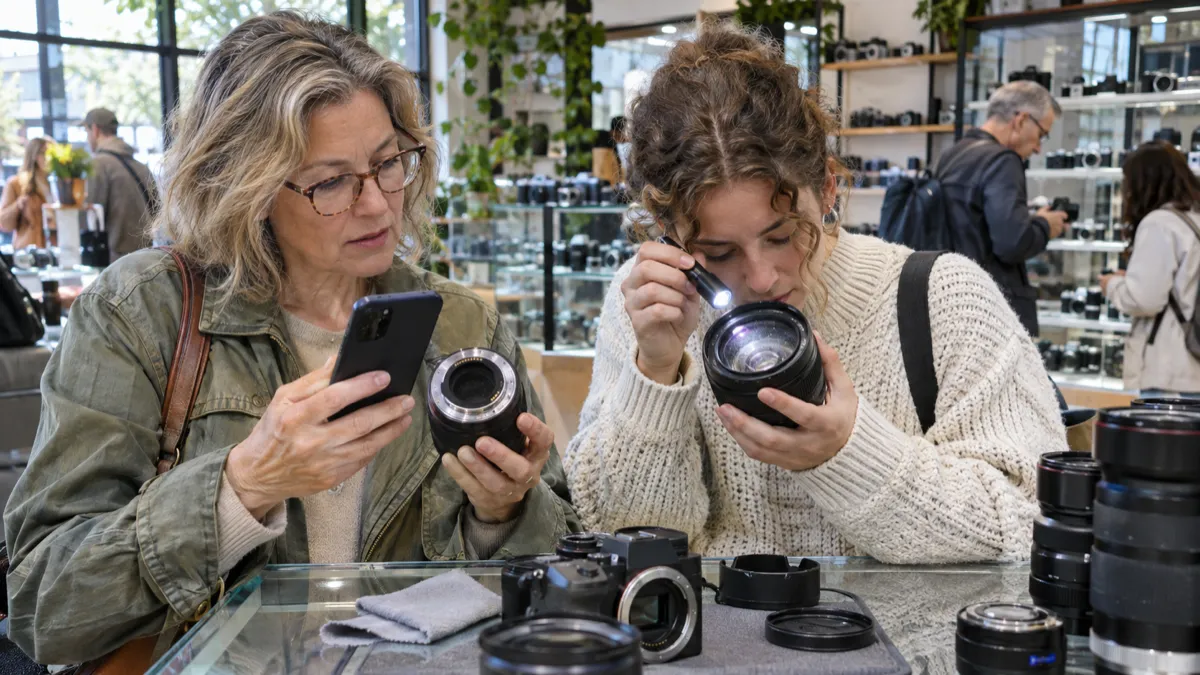
Ask for clear, item-specific photographs of the lens and any reported optical defects. For vintage or Rolleiflex-style optics, used-camera guidance identifies scratches, fungus, interior dust and element separation as conditions worth investigating; excessive interior dust may sometimes be described as haze. That advice should not be treated as a universal grading standard for every interchangeable lens, so ask the seller to explain exactly what “haze” means.
Do not treat the word “haze” as a harmless grade. Ask whether the seller means surface fingerprints, interior cloudiness, dust or separation, and request a return option if the description is unclear. The effect of a mark depends on its position and severity, so a photograph alone may not tell you how the lens will perform.
Fungus and separation are reasons to be cautious rather than optimistic. If a lens has fungus or separation, ask a qualified repairer whether inspection is worthwhile before buying. If the seller cannot provide useful photographs or answers, move on instead of trying to price an unknown repair.
Inspect the mechanics, not just the barrel
Pay particular attention to the mount and to controls that bind; cosmetic wear is a separate condition question. Nikon’s factory lens service checks the bayonet mount, zoom operation, focus operation, focus accuracy, aperture or diaphragm function, switches, buttons, contact communication and firmware. That is a useful outline for a serious buyer’s inspection.
Check that the focus and zoom controls operate smoothly and consistently through their travel. Check the aperture or diaphragm function and, for electronic lenses, confirm lens-contact communication on a compatible body.
Check the mount and confirm that lens contacts communicate reliably with the camera. Also check the switches and buttons that the camera and lens are supposed to provide.
Autofocus has to work on your system
If possible, test focus operation and accuracy on a compatible body, and confirm that the exact lens and mount are supported. A lens can appear mechanically sound while still failing to communicate correctly with a particular camera.
Autofocus performance is system-dependent. DPReview explains that a focusing motor that behaved well on a DSLR may feel different on a mirrorless camera, especially for video. For third-party optics, look up reviews of the exact lens and mount rather than relying on a review of a similar focal length or another generation. If a firmware dock or update tool is required, confirm that the model remains supported.
Confirm that the exact lens and mount are supported, including any electronic features you rely on. A listing that says “works with Sony” or “fits Canon” is not precise enough by itself: camera generations, mount variants and firmware can change what the lens actually does.
Read the listing as evidence
Look for clear, item-specific photographs, specific condition notes and a stated return policy. Stock photographs, vague grades and “untested” wording describe uncertainty, not condition. Ask focused questions through the marketplace so the answers remain part of the transaction record.
Seller history helps, but feedback does not replace testing. DPReview recommends checking a seller’s completed history and understanding the retailer’s return policy before buying. A specialist used dealer may cost more while providing item-specific photographs, inspection notes or a defined warranty; that convenience can be valuable for expensive optics.
eBay’s Authenticity Guarantee page describes the service for eligible luxury and collectible categories, including shoes, handbags, watches, apparel, jewelry, trading cards and coins. It does not present the program as a general camera-lens inspection service. Do not assume a lens is covered. Use the platform’s checkout and protection terms, and be wary of requests to pay or communicate outside the marketplace.
Use the return window as your final inspection
When the lens arrives, inspect it promptly and use the return window to report any mismatch or fault.
Mount the lens carefully and check focus operation, aperture, switches, zoom and manual focus. Check the mount and confirm that electronic communication works as expected on your camera. Confirm that the exact lens and mount are supported, including any electronic features you rely on.
If you find fungus, a damaged mount, unreliable communication, a sticking control or a material mismatch with the description, stop experimenting and document it. Keep the messages, photographs and original packaging. Follow the marketplace’s return process rather than accepting an informal partial refund that leaves you responsible for an optic you do not trust.
- Before buying: confirm the exact mount and sensor format; request actual item-specific photographs; ask directly about fungus, haze, scratches and separation; check autofocus and firmware compatibility; read the return terms.
- After delivery: inspect the mount and contacts; test focus, aperture, zoom and switches; compare the condition with the listing; start a return promptly if a major fault appears.
Check recalls and choose the reliable lens
Search the U.S. Consumer Product Safety Commission’s recall database for the product. CPSC says its recall data updates weekly, while remedy information can change more frequently. For electronic lenses, check the manufacturer’s documentation for any applicable firmware information.
The safest used-lens purchase is the one whose condition, compatibility and return path are all clear. Spend the budget on a clean lens with dependable controls before chasing a faster aperture or rare version. A modest same-brand or well-supported third-party lens that works every time will produce more useful photographs than a prestigious optic you cannot confidently test.
For a purchase linked from a marketplace, keep the decision grounded in evidence: the exact model, the exact mount, honest photographs, a clear description and a usable return route. If one of those pieces is missing, the apparent bargain is really an unknown repair or compatibility problem.
Sources
- DPReview: How to buy used gear (and not get burned)
- DPReview: What you need to know before buying your first lens
- DPReview: Secure your next purchase: a guide to buying used gear without worry
- Nikon Imaging USA: Factory Maintenance & Cleaning
- B&H eXplora: Buying a Used Rolleiflex TLR
- eBay: Buying with Authenticity Guarantee
- U.S. Consumer Product Safety Commission: Recalls & Product Safety Warnings
Specifications vary by model and reference — always check the individual listing.