
How to Tell If a Watch Is Real Gold
Learn how to tell if a watch is real gold using hallmarks, magnet and weight checks, paperwork, seller clues, and professional testing before you buy.
Updated November 13, 2026 · Sources last checked November 13, 2026
Our take
If you are buying a pre-owned watch and need to know whether its case is genuinely gold rather than gold-colored, begin with the markings and listing evidence, then use magnet and weight checks only as screening tools. For an expensive or uncertain watch, choose a seller with a credible return or authentication route and arrange professional metal testing before treating it as solid gold.
Start with the case markings
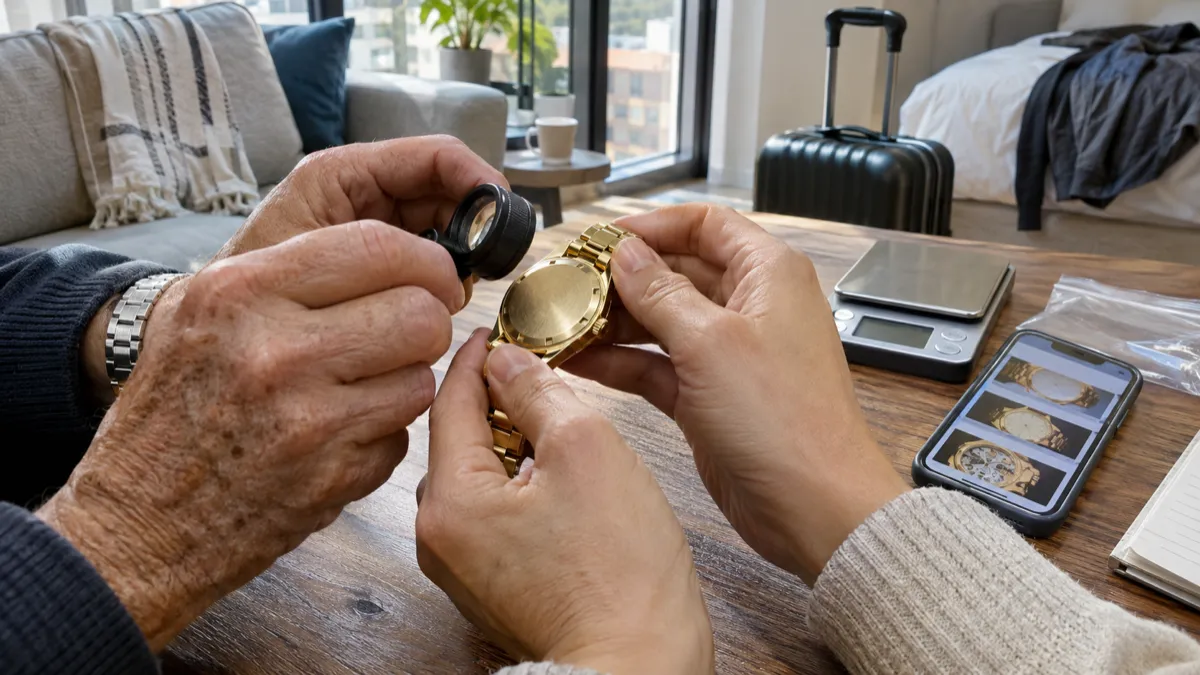
The quickest answer to “how do I check if my watch is real?” is to inspect the case, not just the dial. Use a loupe to examine the inside of the case back, case edge, lugs and clasp. A karat mark such as 14K or 18K states the claimed gold content: 18K is 18 parts gold out of 24, while 14K is 14 parts. Look for a maker or responsibility mark nearby and compare it with the brand’s records or a reputable reference guide.
A hallmark is more useful than a warm yellow color, but it is not proof on its own. Stamps can be false, worn or attached to a replaced case back. Terms such as gold plate, gold-filled, rolled-gold plate, gold cap, gold electroplate, gold flashed and gold washed describe a gold layer or coating over another material, not a solid-gold case. These labels describe different constructions, so ask what metal lies underneath and how substantial the gold layer is.
In jewelry terminology, “solid gold” usually indicates that the piece is not hollow; the karat mark still determines its gold content. Genuine gold watch cases are commonly alloys made harder with other metals, so check the karat and construction instead of relying on the word “solid” in a listing.
- Photograph the marks in the listing and request sharp close-up images if they are missing.
- Check that the mark applies to the case or bracelet component being sold, not just a buckle, crown or detachable part.
- Pause if the stamp is blurred, a maker mark is missing, or the listing and watch appear inconsistent.
Compare the clues that matter
No single home check proves a watch is real gold. Combine independent clues, giving the greatest weight to matching documentation and professional inspection. This is the practical difference between finding a promising watch and confirming one.
| Check | What it can reveal | Main limitation |
|---|---|---|
| Hallmark and maker mark | The claimed karat, responsible maker and sometimes an official national or international hallmark | A stamp can be counterfeit, worn or located on another component |
| Magnet | Whether exposed ferrous metal is attracted to a magnet | Gold is not magnetic, but many non-magnetic metals also pass |
| Weight and feel | Whether a case seems unusually substantial beside a comparable steel version | Movement, bracelet, crystal, hollow construction and mixed metals alter the result |
| Documentation | Whether reference, serial, case material and service history fit the watch | Papers can be missing, mismatched or fabricated |
| Professional assay | A specialist’s assessment using methods such as touchstone testing or X-ray fluorescence | Some methods read mainly the surface, while chemical testing can mark the watch |
Use magnet and weight checks carefully
A small magnet is a useful first filter, not a verdict. If the case or bracelet strongly attracts it, ferrous metal is present somewhere in the tested part, which is a warning. If nothing happens, you have only ruled out one obvious magnetic response; non-magnetic steel, brass, copper and other alloys can still be mistaken for gold. Keep the test away from the movement and do not drag a strong magnet across a mechanical watch.
Weight can add context. Gold is dense, so a solid-gold case and bracelet often feel heavier than a visually similar steel or plated watch. Compare like with like: the same reference, bracelet configuration, crystal, movement and removed accessories. A lightweight dress watch may be hollow or thinly plated, while a heavy watch can contain steel, a dense movement or mixed metals. Do not treat an online weight figure as proof unless it matches the exact reference and configuration.
A home density test sounds scientific, but watches are awkward objects: water resistance, trapped air, hollow parts, straps and the movement complicate the result. GIA’s comparison of jewelry-testing methods found limitations across the techniques it examined and judged hydrostatic weighing the least suitable of those methods. Use weight as supporting evidence, never as a pass-or-fail test.
Make the paperwork and listing agree
Ask for the exact reference, serial details where appropriate, case-material description, purchase receipt or service record, and clear images of every relevant mark. The important question is whether the evidence describes the same watch in front of you, not whether it comes with a box. A gold-colored dial, gold-tone hands or a gold-plated model does not establish that the case is gold.
For a pre-owned purchase, seller behavior is evidence too. Specific answers, consistent photographs, a clear return policy and disclosure of replacement parts are reassuring. Phrases such as “looks like gold,” “gold style” or “untested” signal uncertainty rather than confirmation. If an eligible eBay watch uses Authenticity Guarantee, eBay says the item is checked by its authentication service before it is sent on or returned; read the current listing and program terms because eligibility and conditions vary.
Know when professional testing is necessary
Professional testing is worthwhile when the price reflects solid gold, the hallmark is absent or suspicious, the watch is vintage, the case has been heavily polished, or the magnet and paperwork disagree. A reputable jeweler, watchmaker or assay specialist can inspect the case and explain whether the result applies to the case, bracelet, bezel or only the tested spot.
X-ray fluorescence can provide a non-destructive composition reading, but surface testing has limits on plated or layered objects. Touchstone testing is relatively quick and less destructive, yet it uses acids and may require an unobtrusive test area. GIA describes these methods as useful within their limitations and stresses that appropriate equipment and procedures matter. Do not scratch, file, heat or apply acid to a valuable watch yourself unless a qualified professional has accepted the risk and you understand what may be damaged.
The buying decision is straightforward. Choose a lower-risk pre-owned watch with clear marks, matching documentation, a credible return route and authentication when available if you cannot inspect it in person. Choose professional testing before purchase, or walk away, when the seller will not provide case-mark photos, the price assumes solid gold, or the evidence does not line up. A magnet that does not stick is encouraging; it is never the final answer.
- Before buying: verify the exact case material, request hallmark close-ups, compare reference details, and confirm return and authentication terms.
- After delivery: photograph the watch as received, recheck the marks and condition, and arrange professional testing promptly if the evidence differs from the listing.
Sources
- Federal Trade Commission: Buying Platinum, Gold, and Silver Jewelry
- Gemological Institute of America: Methods for Determining the Gold Content of Jewelry Metals
- Gemological Institute of America: Bench Tip #9, Touchstone Method
- IWC Schaffhausen: Technical Details
- Swiss Federal Office for Customs and Border Security: R-243 Precious-Metal Control Guideline
- eBay: Selling with Authenticity Guarantee
Specifications vary by model and reference — always check the individual listing.