
Which Portable Power Station Is Best for Your Needs?
Find the right portable power station by matching capacity, output, charging, battery chemistry and backup priorities to your real-world needs.
Updated November 14, 2026 · Sources last checked November 14, 2026
Our take
For most buyers, the best portable power station is a mid-sized LFP model with enough continuous AC output for the devices they actually need, plus the right ports and a backup mode if uninterrupted power matters. Choose a smaller unit for occasional camping and a larger expandable system for refrigerators, pumps or repeated outages; a pre-owned station can be worthwhile only after checking its exact model, condition, accessories and recall status.
Start with the load, not the brand
The right answer to “which portable power station is best?” depends on two separate questions: how much energy must the battery store, and how much power must it deliver at one moment. Capacity is expressed in watt-hours (Wh), while output is expressed in watts (W). Wh helps estimate how long a load may run; W determines whether the station can run that load at all.
A compact, lower-capacity station is a sensible shape for phones, cameras, laptops, lights and short trips. A unit around 1,000Wh is a more flexible middle ground for networking equipment, a television, a small refrigerator or several devices during a short outage. Larger systems make sense when you need longer runtime, more starting power or extra battery modules, but their size changes the ownership experience: they are often moved with wheels rather than carried.
For a rough runtime estimate, divide the advertised Wh by the device’s wattage, then allow for conversion losses and the fact that not all rated capacity is available to the appliance. A 100W device therefore should not be promised ten hours from a 1,000Wh station. Motors, compressors and heating elements may also demand a short surge above their normal running draw, so check both continuous and peak figures.
Output determines what is usable
A large battery is not enough if the inverter cannot supply the required load. Check continuous AC output first, then peak or surge output for refrigerators, pumps, power tools and other motor-driven equipment. If most of your devices charge by USB, inspect the USB-C rating and port count too: direct DC charging can avoid running a separate AC adapter through the inverter.
The EcoFlow DELTA 3 Plus is specified at 1,024Wh and 1,800W, the Jackery Explorer 1000 v2 at 1,070Wh and 1,500W, and the Bluetti AC180 at 1,152Wh and 1,800W. Those exact figures make them useful reference points, not interchangeable recommendations. Compare the outlets, USB-C capability, surge rating, dimensions and included cables against your own equipment.
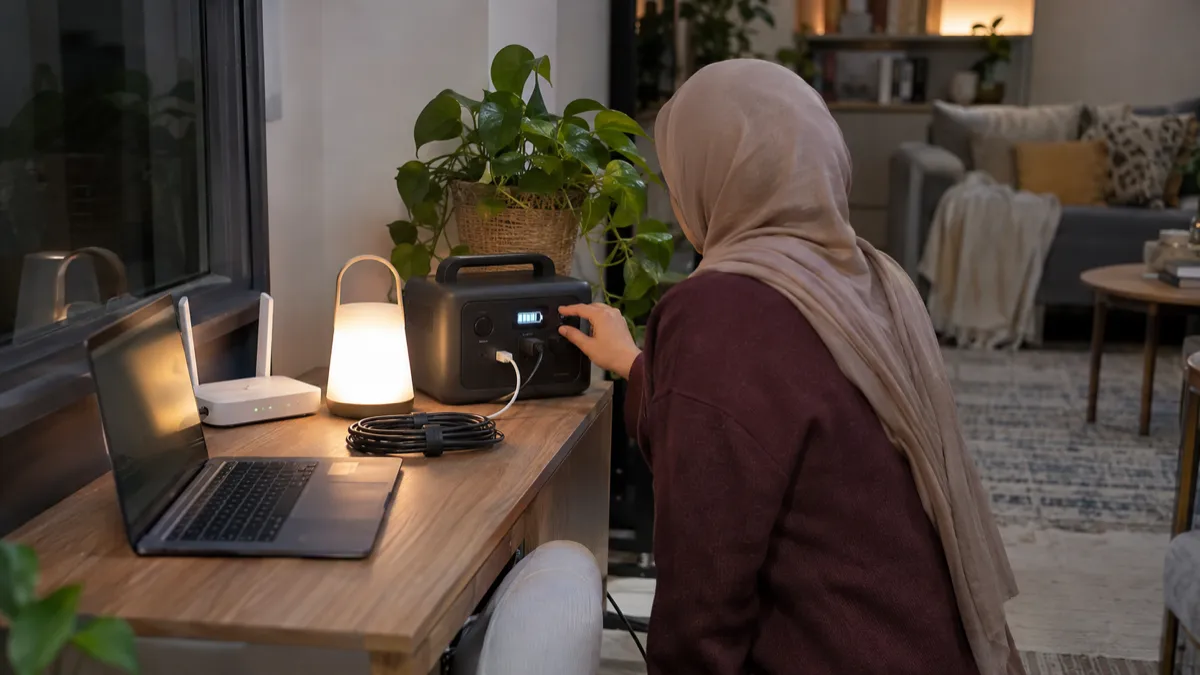
A UPS mode matters for a router, modem, desktop or other device that should not reboot during a blackout. EcoFlow specifies a sub-10ms UPS for the DELTA 3 Plus. Jackery’s Explorer 1000 v2 support information describes a 20ms transfer and its documentation warns that it is not a zero-interruption UPS for equipment requiring one. For medical equipment, servers or permanently installed backup, follow the equipment maker’s requirements rather than assuming any portable station is suitable.
The important differences side by side
These are reference choices rather than a universal ranking. The trade-off is straightforward: more output and expansion improve backup flexibility, while lower weight and simpler charging improve everyday portability.
| Option | Published specifications or characteristics | Choose it if… | Main compromise |
|---|---|---|---|
| EcoFlow DELTA 3 Plus | 1,024Wh, 1,800W AC, LFP battery, solar input up to 1,000W, sub-10ms UPS and expandable battery support | You want fast recharge, expansion and a quick-transfer backup mode | It offers more capability than a casual device-charging setup needs |
| Jackery Explorer 1000 v2 | 1,070Wh, 1,500W total AC output, LiFePO₄ battery, solar and car charging, 20ms transfer | You want a general-purpose station with a published weight of about 10.8kg | Its 20ms transfer may not suit equipment that requires zero-interruption backup |
| Bluetti AC180 | 1,152Wh, 1,800W AC, LiFePO₄ battery, solar and car charging; the manual lists a weight of about 35.27lb | You need stronger AC output for small appliances and can tolerate a heavier unit | Its weight makes it less pleasant to carry, so check the exact USB and accessory arrangement |
| Compact lower-capacity class | A smaller-capacity category generally aimed at USB devices, lights and lighter loads | Your priority is camping, photography, laptops or emergency phone charging | Runtime and appliance capability are limited |
| Large expandable system | A category built around more capacity, higher output and additional battery modules | You need longer outages, refrigerators, pumps, tools or multi-day backup | It is heavier, more expensive and less portable in daily use |
Recharge options are part of the decision
Wall charging is the baseline, but the most useful recharge method depends on where the station will live. Fast AC charging helps before a storm or between trips. Solar input can extend an outage, but panel placement, weather, daylight and cable compatibility determine the result; solar should be treated as a recovery plan, not a guaranteed refill schedule.
Car charging is useful for road trips and can keep a smaller station topped up while driving. Check whether the exact model supports charging and discharging together, which inputs can operate simultaneously and whether the required adapters are included. The DELTA 3 Plus lists AC, solar and car charging with solar input up to 1,000W. Jackery’s Explorer 1000 v2 support page lists a 200W single-port or 400W dual-port solar input and states that its solar and car charging cannot be used simultaneously.
The practical question behind “what size solar generator do I need?” is how much essential energy must survive the night or a period of poor weather. Size the battery around those loads first, then choose panels that fit the station’s input limits and your available space. If you need automatic household energy management rather than a movable battery, an installed home-storage system belongs in a different comparison.
Chemistry and condition matter more for used buyers
Battery chemistry affects the compromise between durability, weight and design. LFP, also called LiFePO₄, is used in all three reference models above; the manufacturer pages and manual identify the chemistry for each. Do not treat chemistry as a substitute for checking the inverter, protections, age, storage history, warranty position and exact generation.
For a pre-owned unit, ask for the full model number rather than accepting a family name such as “1000” or “Delta.” Confirm that the AC charger, car cable and any solar adapters are present. Inspect the housing, display, ports and cables, and avoid a unit with swelling, cracks, heat damage, unexplained shutdowns or a battery that drops unusually quickly under a modest load.
Recall checking is essential. The CPSC says EcoFlow DELTA Max 2000 Model EFD310 units were recalled because they could overheat and ignite, with the recall dated October 9, 2025. It also says Goal Zero YETI 3000X units were recalled because a circuit board could overheat, with that recall dated August 20, 2026. Those notices concern different models from the three comparison units, but they show why a used listing should be checked by exact model and not by brand name alone. Follow the manufacturer’s charging, storage and temperature instructions, and do not use a damaged battery.
- Write down the wattage of each essential device and the number of hours you want it running.
- Check the exact model number, chemistry, included charger, cycle information, warranty position and CPSC recall status.
- Match the AC, USB-C, solar and car ports to the devices you already own. Do not assume every accessory is included.
The best choice depends on the scenario
For occasional camping, camera work or phone-and-laptop charging, choose a compact LFP station with USB-C and car charging. It is easier to move and avoids paying for high AC output that your equipment never uses. If you regularly run a refrigerator or several appliances, move up rather than hoping a small battery will cover a larger load.
For short home outages and limited essential loads, choose a mid-sized LFP station whose continuous output covers those devices and whose transfer behavior suits them. The EcoFlow DELTA 3 Plus is the clearest fit when rapid recharge, expansion and a fast transfer mode are priorities. The Jackery Explorer 1000 v2 is the more sensible match when its portability and straightforward charging arrangement matter more, provided a 20ms transfer is acceptable for your equipment.
For a refrigerator, pump, power tools or repeated outages, choose a higher-output expandable system and plan around startup surge and overnight energy use. The Bluetti AC180 is a reasonable middle option when its 1,800W AC rating suits the load and you can live with its weight. For long blackouts, select the system with the clearest expansion and recharge plan rather than simply the largest headline capacity.
Are portable power stations worth it? Yes, if you need quiet, movable power for short outages, travel or outdoor work and can accept finite runtime. They are not a complete replacement for a fuel generator or installed home battery during an extended outage, particularly if you need central heating, air conditioning or several high-wattage appliances. The best purchase is the smallest safe system that covers your essential load, recharges within the time you have and remains practical to move.
Sources
- EcoFlow DELTA 3 Plus official product page
- Jackery Explorer 1000 v2 official support page
- Bluetti AC180 official manual
- TechRadar best portable power stations
- WIRED best portable power stations
- CPSC EcoFlow DELTA Max 2000 recall
- CPSC Goal Zero YETI 3000X recall
Specifications vary by model and reference — always check the individual listing.