
Headphones buying guide: over-ear, earbuds and noise cancelling
Choose headphones by form factor, ANC, codecs, comfort, battery and connection type, with practical checks for buying refurbished or used pairs safely.
Updated October 10, 2026 · Sources last checked November 13, 2026
Our take
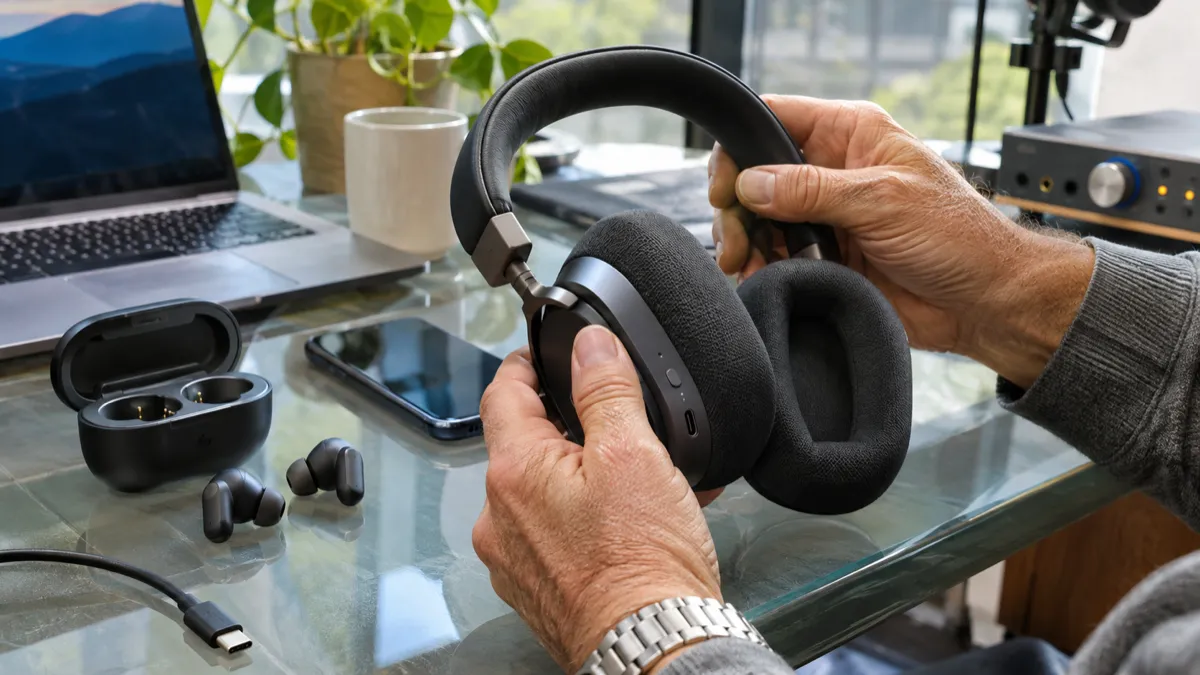
Buy over-ear headphones if you want strong isolation, long-session comfort and the best chance of a useful wired fallback. Choose true wireless earbuds for commuting, exercise and pocketability, especially if your phone ecosystem matters more than marathon battery life.
Noise cancelling is worth prioritising for aircraft, trains and busy offices, but it adds electronics and another battery to age. For pre-owned buying, a clean, complete pair with a demonstrably healthy battery is a better bet than a newer model with missing accessories or vague condition notes.
Start with the shape
Over-ear headphones surround the ear. Their larger pads can create a stable seal and leave room for substantial batteries, microphones and control hardware. They are usually the sensible choice for long flights, desk work and home listening, though they take up more space and can feel warm. Check whether the headband presses on your crown and whether your glasses break the pad seal; RTINGS found that glasses can change the fit and therefore the listening result on the Sony WH-1000XM5.
On-ear models rest on the ear rather than enclosing it. They can be lighter and less hot, but the pressure is concentrated on the ear and outside noise gets in more easily. They make sense when compactness matters and you do not need strong isolation.
True wireless earbuds disappear into a pocket and stay out of the way during walks or workouts. The trade-off is a much smaller battery in each bud, tiny controls and a fit that depends on the ear tips and your anatomy. Apple’s AirPods Pro 2, for example, use interchangeable tips, pressure-equalising vents and an IP54 dust-, sweat- and water-resistance rating; those are useful features, but they do not make every earbud a safe choice for swimming or heavy rain.
| Form factor | Best for | Main compromise |
|---|---|---|
| Over-ear | Travel, offices, long sessions | Bulk, heat and a heavier headband |
| On-ear | Light packing and casual listening | Less isolation and possible ear pressure |
| True wireless earbuds | Commuting, calls, exercise | Shorter bud battery life and fit dependence |
Treat ANC as a tool, not a promise
Active noise cancellation uses microphones and inverse sound to reduce outside noise. It is most convincing against steady, low-frequency sounds such as engines and road rumble. It is less complete against sudden voices, clattering dishes and irregular sounds, so passive sealing from the pads or ear tips still matters.
Independent testing is more useful than a manufacturer’s broad claim. RTINGS measured the WH-1000XM5 as especially effective in office-chatter and bus-engine scenarios, while also noting that its automatic optimisation can change with head movement. That is a reminder to look for test results in the places you actually listen, not just a label saying “adaptive ANC.”
Transparency or aware modes are almost as important as cancellation. They let speech and traffic through without removing the headphones, but the quality varies. Try the controls, check whether the mode can be reached without opening an app, and remember that ANC is not hearing protection unless the manufacturer specifically documents that use.
Codecs matter after fit and source
A Bluetooth codec is the method used to compress audio between the phone and headphones. Both devices must support the same codec, and the connection normally falls back to a shared option. SBC is the baseline; AAC is a sensible target for Apple devices; aptX variants and LDAC can be useful on compatible Android phones. SoundGuys notes that AAC is consistent on Apple hardware, while Android performance can vary by phone.
Do not buy a codec logo in isolation. SoundGuys also points out that higher-quality codecs can depend on connection strength and device support, and multipoint may restrict which codec is active. Sony’s WH-1000XM5 specification page lists SBC, AAC and LDAC, but the useful point is compatibility: the playback device must support the codec too.
For most listeners, a reliable fit, good tuning and stable connection will be more noticeable than a premium codec. Wired listening remains valuable for planes, consoles and audio interfaces, or simply when the battery is dead. Confirm whether the headphones work passively through the cable; some wireless models still need power for their electronics, controls or equalisation.
Comfort is a specification
Look beyond weight. Pad depth, clamp, headband shape, glasses, hair and heat can decide whether a technically excellent headset stays on your head. An over-ear cup should surround the ear without touching it; an earbud should seal without creating sharp pressure. If you are buying remotely, prioritise a seller with a clear return route because fit cannot be inferred reliably from photographs.
The Sony WH-1000XM5 illustrates why published and tested figures can differ. Sony lists a maximum of 30 hours with noise cancelling on and 40 hours with it off, while RTINGS’ continuous test reported roughly 27 hours with ANC. Use manufacturer figures for the model’s stated ceiling and independent tests for a more realistic comparison, then leave margin for calls, high volume, temperature and ageing.
Battery life is part of the condition
A new wireless headphone’s battery figure is a reference, not a guarantee for a used unit. ANC, codec choice, call microphones, volume and spatial or immersive modes all change runtime. Manufacturer specifications may also separate a standard listening mode from an optional spatial mode, so read the footnotes instead of comparing the headline number alone.
Rechargeable cells gradually lose capacity. In a used over-ear pair, ask how long it plays with ANC enabled, whether it charges normally and whether it shuts down unexpectedly. For earbuds, ask about both left and right buds and the charging case: a case that no longer holds charge can turn a convenient product into a wired or single-use nuisance. Treat codec support as a hardware feature: verify that the exact headphones and playback device support the codec you need before buying.
Refurbished can be attractive when the seller explains the grading, warranty and included accessories. Treat “refurbished” as a condition category, not proof of a fresh battery. If a manufacturer documents serviceable or replaceable battery parts for a particular model, check the exact generation and ask what the listing actually includes; do not assume a used unit has received that service.
- Ask for a recent runtime estimate with ANC on, not just the original box figure.
- Confirm the charging cable, case, ear tips and audio cable are included if the model needs them.
- Check for swelling, heat, a damaged charging port or a battery that drains rapidly; do not use a visibly damaged lithium-ion product.
- Verify the exact generation and regional version before comparing specifications.
Buy used with a hygiene and safety routine
For pre-owned earbuds, hygiene is the first filter. Replace removable tips, clean hard surfaces with the manufacturer-approved method and avoid liquid entering microphones, vents or charging contacts. Do not buy a pair with bodily-fluid staining, corrosion or a case that smells of moisture. Headphones are easier to clean, but peeling synthetic-leather pads, compressed foam and a brittle headband still affect comfort and seal.
Ask for clear photographs of the model label, both earcups or buds, the charging contacts and every included cable. Check that the controls, microphones, ANC, transparency mode, Bluetooth pairing and wired input work. Buyer-level authenticity checks should stay practical: compare the exact model number with the manufacturer’s support page, inspect packaging and app recognition, and avoid listings that refuse basic identification.
Before paying, search the exact model on the U.S. Consumer Product Safety Commission’s recalls database and the manufacturer’s support site. The CPSC page says recall data updates weekly, while remedy information may change daily; check the database before buying and follow any official remedy.
A sensible final checklist is short: fit, battery, cleanliness, connectivity, accessories and return terms. For a new buyer, that sequence matters more than chasing the most advanced codec or the longest advertised runtime. Choose the form factor that you will actually wear, then spend the remaining budget on a better seal, better support and a condition you can verify.
- Test both channels, every listening mode, the microphone and the charging behaviour as soon as the item arrives.
- Keep the model number and serial information, and compare any safety notice with the manufacturer and CPSC pages.
- Return a product with swelling, overheating, charging faults, unexplained shutdowns or an unsafe-looking battery.
Sources
- Sony USA WH-1000XM5 specifications
- RTINGS Sony WH-1000XM5 review
- SoundGuys Bluetooth codec guide
- SoundGuys wireless earbuds guide
- Apple AirPods Pro 2 technical specifications
- Bose QuietComfort Ultra Headphones (2nd Gen) product page
- U.S. Consumer Product Safety Commission recalls
Specifications vary by model and reference — always check the individual listing.