
Best Espresso Machine for Home: Choosing the Right Type
Compare manual, semi-automatic, capsule and superautomatic espresso machines by workflow, drink quality, cleaning and learning curve before buying.
Updated November 13, 2026 · Sources last checked November 13, 2026
Our take
For the best balance of coffee quality, control and a manageable routine, most home buyers should choose a semi-automatic machine, ideally one with a capable grinder or room for a separate grinder. Choose a capsule machine if speed and consistency matter more than recipe control; choose a superautomatic if one-touch milk drinks are the priority; choose a manual machine only if making espresso is part of the hobby, not just the route to caffeine.
The real decision is convenience versus control
The search for the “best espresso machine for home” usually hides a simpler question: do you want to make coffee, or do you want to make the process part of your morning? A capsule machine removes most variables. A superautomatic handles grinding, brewing and, on suitable models, milk preparation. Manual and semi-automatic machines ask more of you, but they give you more influence over the final drink.
The difference changes the counter routine. Loading a capsule is quick, while a semi-automatic workflow can involve grinding, dosing, tamping, locking in the portafilter, steaming milk and cleaning according to the model’s instructions. In return, you can adjust the coffee to suit a new bean, roast level or milk drink rather than accepting the recipe built into a pod or machine.
TechRadar’s current guide describes semi-automatic machines as a way to retain control over grind and brewing, while its tested fully automatic models are aimed at buyers who want the machine to handle more of the process. The best choice is the workflow you will still enjoy after the novelty wears off.
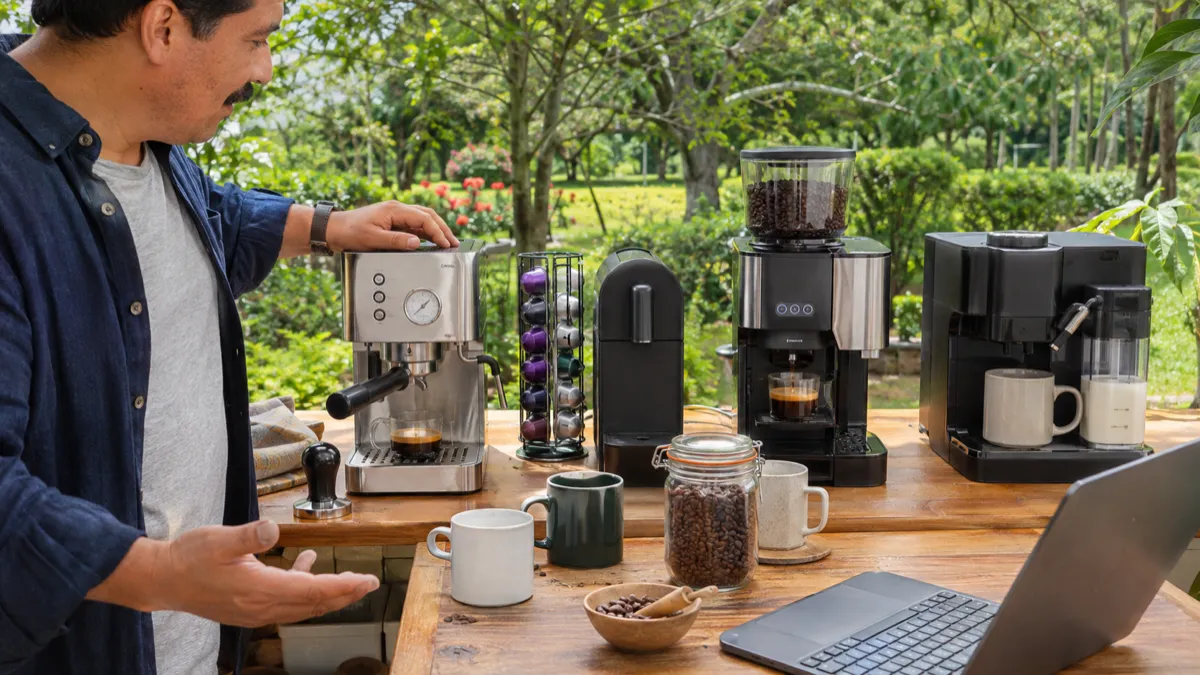
The four types side by side
“Manual” is used inconsistently in product listings. In this guide it means a traditional espresso machine where you prepare the coffee and operate the steam wand yourself; many machines marketed as manual are technically semi-automatic because the pump stops the shot for you. Always check the exact workflow in the listing, especially when buying pre-owned.
| Type | Daily workflow | Drink quality and control | Maintenance | Learning curve |
|---|---|---|---|---|
| Manual | Grind, dose, tamp, brew and steam by hand. | Highest control and the greatest potential for excellent espresso, but technique and grinder quality matter. | Maintenance varies by model; follow the manufacturer’s instructions for cleaning and descaling. | Steepest; the grinder, dose, tamp and milk technique all affect the result. |
| Semi-automatic | You prepare the puck; the machine supplies pressure and heat, with either manual or assisted milk steaming. | A strong compromise for many enthusiasts: fresh beans and adjustable extraction, with room to improve. | Follow the exact cleaning instructions for the model and its included components. | Moderate; guided or assisted models can shorten the path for beginners. |
| Capsule | Insert a compatible capsule, press a drink button and handle the used capsule according to the system. | Consistent and convenient, but the sealed dose limits control over grind, dose and puck preparation. | Follow the machine’s instructions for rinsing, emptying and descaling. | Lowest; little barista technique is needed. |
| Superautomatic | Fill the bean hopper and water tank, select a drink and let the machine grind, dose, brew and often froth. | Convenient fresh-bean drinks with customization, though less direct control than a portafilter machine. | Automatic programmes may reduce effort, but the machine still requires its specified care. | Low; the machine removes most of the manual decisions. |
Semi-automatic is the best coffee machine buying guide answer for many homes
If you want espresso that can improve as your taste develops, start here. The official manual for Breville’s BES878 describes adjustable shot temperature, manual pre-infusion and extraction, programmable shot volume and grind-related controls. In plain language, you can change the preparation and learn how those changes affect the cup.
For a beginner, look for practical assistance rather than an intimidating specification sheet: a built-in grinder with useful adjustment, guided dosing or tamping, a forgiving portafilter, a clear shot timer and a steam wand you can position comfortably. Tom’s Guide and TechRadar both give attention to guided workflows and the balance between assistance and hands-on control in current semi-automatic machines.
The catch is that the machine cannot rescue unsuitable coffee preparation. This is why buying a cheaper machine and spending the difference on a poor grinder can be false economy. If you are buying used, confirm that the grinder, portafilter, water tank, drip tray, tamper and steam-wand tip are present, and ask whether the seller can show the machine heating and dispensing water.
- Choose semi-automatic if you want the strongest balance of quality, control and price; you are willing to learn a repeatable routine; and you mostly drink espresso, Americanos, cappuccinos or lattes.
- Choose manual if the ritual itself appeals to you, you already own or plan to buy a proper espresso grinder, and you accept that excellent results may require repeated adjustment.
Capsule wins the weekday argument
Capsule machines solve a different problem: they make a predictable drink with almost no preparation. Nespresso’s support information explains that Original and Vertuo use different brewing parameters, capsule formats and coffee ranges. It also describes Original as supplying espresso and lungo coffees, while Vertuo offers espresso alongside larger cup sizes. That distinction matters more than a generic “pod machine” label because the system determines the drinks and capsules available to you.
The trade-off is control. TechRadar explains that a single-serve machine brews the coffee contained in the capsule, so you cannot adjust the compactness of the grounds as you would with a portafilter. You also accept the system’s capsule range, waste-handling requirements and milk solution. For someone who wants a fast espresso before work, that may be a worthwhile exchange; for someone comparing beans and refining extraction, it becomes restrictive quickly.
Choose capsule if several people need coffee with different preferences, mornings are rushed, or the buyer wants the smallest learning curve. A pre-owned capsule machine can make sense when the exact capsule system is still supported and the machine’s water path, capsule holder and lid mechanism operate cleanly. Do not buy solely because the listing includes a large bundle of capsules; compatibility and freshness matter more.
Superautomatic removes effort, not maintenance
A superautomatic is the closest match for “press a button and get a latte.” De’Longhi describes its automatic machines as preparing hot and cold coffee and milk drinks at the touch of a button, with model-dependent milk functions and cleaning features. That makes this type attractive to households that want several drinks, use whole beans and do not want to learn puck preparation.
The compromise is access. You can often adjust strength, volume, temperature or grind settings, but you are working within the machine’s brewing system rather than directly shaping the puck. Independent testing from TechRadar and Tom’s Guide shows why this category appeals to convenience-first buyers, while also noting that interfaces and milk systems vary widely between models.
Maintenance is easier to start, not optional. De’Longhi’s out-of-warranty repair service includes professional cleaning and descaling; the exact owner-maintenance routine still depends on the model. Use the manufacturer’s instructions for brew-unit access, grounds and drip-water handling, filters, milk components and descaling. For a used machine, ask for the model number and manual, check that the brew unit or cleaning access is included, and be wary of milk residue, a missing water tank or a machine that has been stored wet.
- Choose superautomatic if multiple one-touch drinks matter more than maximum espresso control; the household wants whole beans without a separate grinder; and everyone agrees that convenience is worth a more complex appliance.
- Choose capsule if the priority is the simplest possible routine and the drink menu can stay within one capsule ecosystem; choose superautomatic if fresh beans, larger drink variety and milk beverages matter more.
Buying new or pre-owned changes the best choice
New gives you the clearest warranty position and the lowest uncertainty, which is particularly valuable for superautomatics with grinders, pumps, brew units and milk circuits. Pre-owned can be a sensible route into a better semi-automatic machine, especially when the design is mechanically straightforward and replacement parts are easy to identify. The saving is less useful if the machine needs a grinder, portafilter, water tank or proprietary milk carafe immediately after purchase.
For any type, compare the actual model and version rather than relying on a family name. Check voltage and plug compatibility, included accessories, age, service history and the manufacturer’s cleaning instructions. A clean, complete machine with a documented maintenance routine is a better prospect than a newer-looking appliance with no working demonstration.
Before buying a named model, search the CPSC recalls page and the manufacturer’s US support page for that exact model number. Stop and investigate any unresolved safety notice, and follow the manufacturer’s warnings rather than relying on a generic category description.
The clear recommendation by scenario
For the best espresso machine for beginners, buy a forgiving semi-automatic if you are curious about coffee and can spare a few minutes per drink. It gives you a path from supermarket beans to better coffee without forcing you to commit to a fully manual setup on day one.
For the busy household, choose capsule. For a family that wants fresh beans and several milk drinks at the touch of a button, choose superautomatic. For the enthusiast on a controlled budget, choose a simpler semi-automatic body and put the remaining budget toward a good grinder; for the committed hobbyist, choose manual only with the grinder, time and patience to match.
That is the practical answer to “which coffee machine should I buy?” Pick the workflow you will repeat, then buy the best-maintained, complete example of that type you can justify. A machine that fits your mornings will produce better coffee over time than a more ambitious model that stays unused because it feels like work.
Sources
- Breville: Barista Pro BES878 Instruction Manual
- Nespresso Support: Original and Vertuo Differences
- De’Longhi US: Automatic Coffee Makers
- De’Longhi US: Out-of-Warranty Service for Fully Automatic Coffee Makers
- TechRadar: The Best Espresso Machines 2026
- Tom’s Guide: Best Coffee Makers 2026
- U.S. Consumer Product Safety Commission: Recalls & Product Safety Warnings
Specifications vary by model and reference — always check the individual listing.